It has been a while! I’ve been busy with marriage stuff and actually getting married the last few months and have neglected the blog as a result. Things are still pretty busy, but I’m hoping they’ll calm down enough by the beginning of September that I can get back to regular updates.
In the meantime, I’m currently reading Gisli Sursson’s Saga, and I came across another of those great, gnomic Viking quips of wisdom. At one point in the saga, the main character, Gisli, learns that his wife had the hots for his brother-in-law, Thorgrim, prior to their marriage. This knowledge will eventually lead to an in-family feud that will end with Gisli’s own death. Upon hearing of his wife’s pre-marital relationship with his brother-in-law, Gisli says, “Fate must find someone to speak through. Whatever is meant to happen will happen.” In saying this, Gisli proves his strength of character by not being jealous or upset with his wife, or even his brother-in-law at this point, and his reaction is a marked contrast to what happens when his brother, Thorkel, hears something similar from his wife. Gisli opts to let Fate take its course, as was considered an ideal, level-headed response during the Viking Age when bad things happened. Fate was a cruel mistress to medieval Norse peoples, but it was important that they not let fear or jealousy into their hearts. As Gisli says, “Whatever is meant to happen will happen.” There is no need to worry, fret, or fear the future as it is destined to happen as it will.
Though, considering what Fate does have in store for Gisli, it’s easy to wonder if he wouldn’t feel differently if he knew what awaited him in his future.
Loki as depicted in the Icelandic manuscript , SÁM 66.
Loki is a hard god to pin down. Though he is known primarily to us through the Marvel Comics character he inspired as an evil, conniving, and selfish god (which he definitely is), he also plays many other roles throughout the course of Norse mythology that make him a far more complex god than all the others except perhaps Odin. At times, Loki is a trickster who plays humorous pranks on the other gods or otherwise gets them into dangerous situations. At the same time, Loki then helps the gods escape from the dangerous situations that he caused himself. Finally, Loki is often terribly malicious and undoubtedly evil. My goal in exploring Loki in many of his various roles is simply to help me understand his purpose and inclusion in the cosmology of Norse myth. Primarily because Loki, unlike the other gods, shows evidence of character development over the chronological course of the mythology and moves from being a helpful (if mischievous) friend to his fellow gods and a sworn brother of Odin, to the evil, treacherous Loki more recognizable to modern audiences. Naturally, there are issues in ascribing a modern character arc to mythology as myths can contradict other myths, which I’ll try to address, or at least point out, when and if any discrepancies actually crop up.
I’d like to first analyze Loki’s place in the cosmology. Loki is described in chapter thirty-four of Snorri Sturluson’s Prose Edda. He is pleasing to look upon, yet underneath the handsome facade hides his true, evil nature. More than anything, the Prose Edda points out that Loki “has the kind of wisdom known as cunning, and is treacherous in all matters.” Loki is the son of Farbauti (cruel-striker), and Laufey (who is also known as Nal). Scholarship suggests that Farbauti’s name refers to lightning, and Laufey to leaves, and says that the result of the combination of lightning and leaves is wildfire, represented by Loki. This corresponds nicely with many of the Loki myths in which he is associated with, or contests against various forms of fire. I’ll come back to this point later. His brothers are Helblindi and Byleistr though not much is known about these two. His wife is the goddess Sigyn and his two sons are Nari and Vali.
But, as the Prose Edda is quick to point out, Loki also had many monstrous children that he fathered with the giantess Angrboda. These “children” will all fight against the gods at Ragnarok. They are the giant wolf, Fenrir, the Midgard serpent, Jormungand, that is so long it can wrap itself around the world and clench its tail in its mouth, and Hel, the ruler of Niflheim and the goddess of those who die ignominious deaths. These monsters all represent various forces that will shape the world of Norse myth as it progresses. Fenrir is raised by the gods, but sensing that he will become a threat to their power, the gods who had fomerly seemingly treated him well betray him and bind him. Fenrir’s eventual escape from his bindings will be one of the various signals that Ragnarok has come. Finally, Loki is also the mother of Odin’s eight-legged horse, Sleipnir.
It’s obvious from just the above mentioned characteristics of Loki and his children that he holds a critical, yet dichotomous position in the cosmology of Norse myth. This is further emphasized by the adventures he shares with Thor and the other gods. The earliest in the chronology of Norse myth is the episode involving the Aesir and the master builder. In this episode, Loki advises the Aesir to strike a deal with a master builder that if he builds a fortress within a certain amount of time he would be given the goddes Freyja as his wife. Loki also suggests the Aesir grant the master builder use of an excellent horse named Svadilfari. When the time the Aesir allotted the master builder to complete the fortress draws near, they are distressed by the knowledge that he will finish the fortress in time and that their vow with him will be forced to stand. They blame Loki for this as he initially advised them on this matter. After the Aesir threaten to kill Loki if he doesn’t find some way out of the conundrum, Loki transforms into a mare and lures Svadilfari off into the woods. The master builder is unable to finish work on the fortress in the time the Aesir gave him without Svadilfari. Angered, the master builder reveals his true nature as a giant just as Thor returns from “hammering trolls.” The thunder god kills the master builder, and everything is resolved. Some time later, Loki gives birth to Sleipnir.
Given the nature of Loki, and his later dealings he has with the Aesir, it is conceivable he purposefully advised the gods poorly in the story of the master builder in order to create the predicament that they find themselves in once the master builder nears the completion of his work, and that Loki prevents the master builder from completing the fortress only because the Aesir threaten him with death. This could be, but I think there is evidence that Loki, while always a trickster, didn’t necessarily become evil until later in the chronological timeline of the myth. This can be seen in a few circumstances. First, I’d like to look at an episode in the Saga of the Volsungs (which is also attested in Snorri’s “Skaldskaparmal,” as well as the Poetic Edda).
I’m just over 900 words, so I’ll call that good for this post and pick up again in the next.
I’m still working on the post I’m writing about Loki. It’s slow going as there is a lot to consider about him, but I thought in the meantime I’d share some Viking wisdom from the Saga of the People of Laxardal. It reads that “…a hungry wolf is bound to wage a hard battle.”
This statement is pretty characteristic of the gnomic wisdom found in other Viking texts; the eddic poem, “Hávamál,” is loaded with similar wise, gnomic statements. In the context of the saga, it refers to a man named Hrut whose brother, Hoskuld, denies him his share of their inheritance left to them by their parents. It isn’t exactly clear how this may have affected Hrut economically, but it can be assumed that without his inheritance he likely wouldn’t possess any land on which he could farm and thus negatively affecting his livelihood. Angered by Hoskuld’s withholding of his inheritance, Hrut steals some of Hoskuld’s livestock and kills two men in Hoskuld’s employ in the process. When Hoskuld learns of the theft, he immediately thinks to seek vengeance, but his wife, Jorunn, counsels him to instead give Hrut the inheritance and mend relations, saying, as quoted above, that “a hungry wolf is bound to wage a hard battle.” Having denied Hrut his ability to support himself financially, Hoskuld has made him both angry, perhaps even desperate for his inheritance, hence the “hungry wolf” metaphor.
At the end of this episode, Hoskuld opts to heed Jorunn’s advice. He gives Hrut his inheritance, and Hrut compensates Hoskuld for the men that were killed as well as the livestock he stole. The two brothers reconcile and the saga states, “From that time onward the two got along as kinsmen should.”
Gylfi is tricked by three aspects of Odin, High, Just As High, and Third, from Icelandic manuscript SAM 66.
Picking up where I left off in the previous post:
Because Gylfi as Gangleri has little of his own personality, he allows the audience of the Prose Edda to engage much more directly with the myths. By removing the personality and motivations of one narrator, the audience’s ability to disbelieve would be lessened as that narrator would not impose his or her own interpretations to the myths, but would rather relate them as they were told, which is an important aspect of oral poetry and transmission. Essentially Gangleri’s lack of personality lets the audience fill his textual shoes making them more receptive to the stories that Odin himself (disguised as High, Just as High and Third) relates. Gylfi’s lack of personality serves to push back the personality of the learner. When they figuratively step into Gylfi’s shoes they leave part of their own personality behind. According to video game theory, this distancing of player personality allows the player to invest their attention more fully into the game that they are playing as well as be more receptive to the information that the game relays to them.
To a young Viking, the narrative structure of “Gylfaginning” could serve the same purpose. As a child, they would know that their family believed in the Norse gods, and thus they would treat the “Gylfaginning” almost as scripture. Immutable, unchangeable, and true. The narrative structure would enhance this sense as they found themselves juxtaposed to their teacher (parents, priests, etc.). The learner would, like Gylfi, pose questions to their teacher that fulfills the same role as the three aspects of Odin. The teacher that possesses the wisdom would then answer the questions of the learner and one can imagine a gruff Viking making snide responses not unlike Odin’s aspects do to Gylfi as they answer his questions. The learner would then learn the story or lesson and internalize it, and prior to the Norse people’s conversion to Christianity, they would have had little reason to actually doubt the stories just as a video game player has little reason to doubt the information the game gives her to actually play it. After all, for a video game to give the player false information would be counter intuitive to the player’s ability to progress further in the game and keep playing. Perhaps without even realizing it, the original composers of what would later become the Prose Edda stumbled onto more than just a teaching tool in its composition, but an indoctrination tool realizing that, if religion gives false information, then what is the purpose in continuing to “play” that religion? If the young Viking’s personality and doubts were allowed to interpose themselves to the stories being taught to them, then they could doubt their veracity. Whether or not the person who composed the Prose Edda set it up in this way intended to do so or not (and I’m inclined to think they did not), indoctrination practices were likely relevant at the time these stories first took their eddic format as the Norse world was facing increasing encroachments by the “new” religion of Christianity that, as Andrew Orchard points out in his introduction to the Elder or Poetic Edda (Penguin 2011), “The twin fatal flaws of Norse pagan belief were that it was fragmented and that it had an uncertain future…was surely no match for the well-defined, written doctrine of muscular Christianity that perhaps inevitable replaced it” (xxxv). Those staunch believers in the Norse gods would have a vested interest in protecting their heritage and beliefs while also indoctrinating their children with those beliefs. Yet, as mentioned previously, Snorri, who wrote the Prose Edda we have today, lived well after Iceland itself had converted to Christianity, and his reasons for writing the Prose Edda would differ from those who first composed these stories.
Even though the narrative structure of “Gylfaginning” at first seems to be structured in such a way as to remove the personality of the learner by linking them to the character of Gylfi, Snorri’s Edda complicates reader/text relationship in various ways. Most prominently are the uses of disguises by both Gylfi and Odin. It is one thing to use the Gylfi as an avatar for the reader/learner, but when he dons a disguise as Gangleri on top of that, things become more complex. Odin’s disguises are even more perplexing. How could a reader trust either Odin or Gylfi when they clearly don’t trust one another and engage in a game of disguise and deception? Snorri, being a Christian, possibly even wrote High, Just as High, and Third as suspicious characters whose stories should be viewed just as suspect as they are. Furthermore, “Gylfaginning” itself translates to “the deluding of Gylfi,” but that doesn’t specify how he was deluded. Yes, he is tricked by Odin’s disguises, but he could also have been tricked by the stories Odin actually tells him. This implies the stories themselves are trickery meant to delude Gylfi from the truth (in this case, the Christian truth), which nicely aligns the narrative structure of “Gylfaginning” with Snorri’s introduction to the Prose Edda where he goes to great length to state that these old stories of the Norse gods are not true. Jesse Byock says in his introduction to the Prose Edda (Penguin, 2005), “Rather than reconstructing cultic practices of the old religion…the Edda concentrates on what was still known a the time of its composition: myths, legends, and the use of traditional poetic diction” (xi). The dialogic structure of “Gylfaginning” also serves this purpose on a stylistic level furthering the notion that while Snorri’s society still held these myths and legends in high regard, they recognized them as being artifacts of a bygone era.
So in answer to my questions posed at the beginning of my last post, Snorri wrote the Prose Edda in a dialogic format to keep the myths and legends therein true to their original source material. The narrative structuring of the Prose Edda serves the purpose of both teaching readers and learners the myths while also reinforcing the fact that the stories should be viewed as not true (something any Christian of the time period would want to prove should the church come knocking), and merely as cultural artifacts.
That does it for this inquiry. Next I think I’d like to analyze the Norse god, Loki, in order to better understand his character and his place within the Norse cosmology.
One of the most striking aspects of Snorri Sturluson’s Prose Edda has nothing at all to do with the myths, legends, and stories recounted therein, but instead in the way the stories are told and presented to the reader. “Gylfaginning,” the first section of the Prose Edda is told as a dialogue between the character Gylfi, who is in disguise and goes by the name Gangleri, and three aspects of Odin named High, Just as High, and Third. The second section, “Skaldskaparmal” is likewise a dialogue between Aegir (probably the giant of the same name), and the legendary poet Bragi. Needless to say that it is an interesting way to present the stories of Norse mythology especially when the Icelandic sagas were being (at the very least) transcribed around the same time that Snorri wrote the Prose Edda. Why tell the stories in this way when third person prose narrative was widely used by his contemporaries and even himself? And what does the narrative structuring of the Prose Edda tell us about these mythological stories?
Before continuing, I need to write just a couple of disclaimers. First, I imagine a lot of scholarship has been written on this topic, to which I don’t really have much access. Second, the truth is I can’t give definitive answers to the above questions, but I hope that I can find some logical conclusions in analyzing the Prose Edda‘s dialogic storytelling. That being said, I’ll continue.
An obvious answer to my first question above as to why Snorri wrote the Prose Edda in a dialogic format is because these stories already existed in other forms prior to Snorri’s writing. Namely, the stories that comprise the Prose Edda were taken from pre-existing oral and poetic sources. Fortunately we still have access to the Poetic Edda (also sometimes referred to as the Elder Edda), and the two works align quite well despite a few differences which I won’t go into here. However, while the poems that comprise the Poetic Edda do contain dialogue, they do not take a purely dialogic form like the Prose Edda. So while many of the stories are the same, their presentation is even more divergent than simply one being in prose and the other in poetry. Why present one differently from the other is a good question, and the answer lies in oral transmission.
While all of the poems of the Poetic Edda were probably transcriptions of earlier poetry that only existed orally, the format of Snorri’s Edda hints towards another pre-existing form of these stories. There are many theories as to the derivation of the word, “edda.” Recent studies consider the word to be an amalgamation of words from various languages making it a layered word with multiple meanings, with “creed” and “superstition” among these. Earlier theories equated the word with an instance of its appearance in the eddic poem, “Rigsthula,” where it translates to “grandmother,” making the the edda grandmotherly tales of a bygone era. Snorri was born well after Iceland’s conversion to Christianity, but I think it is likely that eddic stories were transmitted orally in a non-poetic form. Though I think that people in medieval times had a much stronger foundation in poetry than we do, I find it doubtful that everyone was a poet, or that everyone had memorized the entire catalog of eddic poetry. There must have been some way people who were not wealthy or did not have access to the Poetic Edda to transmit their beliefs from one generation to the next, and I think it is possible Snorri’s Prose Edda could be a successor to that method. Thus “edda” could refer to the stories that a person from one generation uses to teach the children of the younger generation the stories of the gods of Norse mythology. This would also account for the dialogic narrative structure the Prose Edda uses.
In a time when there was not really any system of formal education outside of religion and those rich enough who had the desire or the necessity to learn to read and/or write, teaching children the religion, beliefs, ideals, and mores of a given culture would fall to the family. For this reason, I think it is likely that Snorri’s Prose Edda is the successor to oral tales told to children by those who didn’t necessarily have a predilection towards poetry whether they were of a lower social rank, or did not have the poetic skill necessary to recite or compose poetry. Snorri likely did his scholarly duty when writing the Prose Edda by cross-referencing eddic stories with source eddic poetry, and generally making his Prose Edda as accurate as possible. After all, he was a poet, scholar, and historian, striving for accuracy (or at least as accurate as he could get) working with stories that, while clearly still a cherished part of Icelandic culture at the time of his writing, were the legacy of a pagan era that had already been gone for over a hundred years at the time of his writing. And while any goal Snorri had in mind while writing the Prose Edda is a mystery to us now, they clearly have an educative quality on many levels.
First and foremost is the very dialogic narrative structure I’ve already mentioned above. When Gylfi disguised as Gangleri arrives at the hall of High, Just as High, and Third, he comes seeking knowledge. He asks the three aspects of Odin various questions throughout “Gylfaginning,” which they then answer (if at times sardonically). The purpose is to educate Gangleri of Norse cosmology, its gods, and their doings. In some ways, particularly because of his lack of personality, Gangleri serves as a vehicle through which real life readers and audiences can likewise gain experience and knowledge with him. In video game terms, Gangleri could be seen similarly to a game player’s avatar. As the avatar becomes more knowledgeable in the world it inhabits, so too does its audience, and vice-versa.
I’m just over a thousand words now, so I’ll explore this in more detail in my next post. Sorry for the delay in getting this one posted.
Battle of the Doomed Gods, by Friedrich Wilhelm Heine. Depicts Freyr fighting Surt (left), Odin fighting Fenrir (center), and Thor fighting Jormungand, (center-right).
(Continuing my discussion from the previous post.) Norse myth venerated the warrior, and to die fighting in battle was the ultimate honor as it meant the warrior would spend the afterlife in Valhalla, the hall of the slain, as an Einheri (The plural form is the more familiar Einherjar. Thanks to linalaukaR for pointing this out). There they would fight, drink, and feast daily to prepare for Ragnarok where they would fight alongside the gods. So though the gods fear Ragnarok, the greatest honor a mortal could have prior to its coming is to be an Einheri, which shows that the gods considered their eventual demise, violent though it is, as glorious. Those mortals who died of disease or old age, went to Niflheim, ruled by Hel, the daughter of Loki. Baldr also goes to Niflheim when he dies, so it would seem that others who die “ignominously” also end up in Niflheim. And though Baldr seems to be treated well enough (despite the fact that Hel’s terms for releasing him are pretty extreme), it wasn’t really fair that these people would go to a dark, misty realm and be ruled over by a severe goddess (after Ragnarok, the realms change drastically, and the afterlife seems to be more fair for everyone involved, which could be the topic of another post). However, the veneration of the warrior does show the extent to which Norse myth supported a life of active pursuit to provide for oneself, one’s family, and to keep them safe.
Unfortunately, it would be remiss to not note that often times this active pursuit came at the expense of others’ lives due to the Vikings’ inclination towards raiding and pillaging. So while the Vikings’ gods fought long and hard to keep the universe safe from monsters, the Vikings themselves were often the “giants and monsters” encroaching beyond the safe borders of neighboring cultures. Still, Norse mythology retains many fascinating symbols, and metaphors that relate the nature of human existence as well as the extent to which effort is required in order to maintain that existence.
That wraps up this discussion! I’m thinking that next I’ll look at the narrative technique of “Gylfaginning.”
Thor’s Battle Against the Jötnar (1872) by Mårten Eskil Winge
Picking up where I left off, it would seem given the struggle and effort of the Norse gods to preserve the universe that something poses a greater threat to them than Ragnarok. Perhaps without their even realizing it, the Norse gods act in such a manner as to prevent these threats from overcoming them and laying waste to their universe.
But what are these threats? The answer lies within the actions of the gods themselves. First, as I mentioned previously, Odin seeks knowledge so that he may have the wisdom to delay Ragnarok and so that he may be prepared when it does inevitably occur. Thus the threat that Odin combats is ignorance. Second, Thor spends much of his time fighting frost giants and monsters in order to prevent them from encroaching the borders of Midgard and Asgard. It takes tremendous courage on Thor’s part to do so, and he is not always able to maintain that courage for which Odin criticizes him in the poem “Harbardsljod.” Thus we see that the second great peril for the Norse gods is cowardice. Finally, the gods must actively defend, strengthen, and heal any damages to the universe. I specified the Norns in particular for this role in my last post, but the actions of the other gods shows that they too take an active role in the defense of the universe. If they were to grow lazy, or indulgent in their own power the universe would fall apart. Thus the third and final threat to Norse myth is passivity.
So, let’s look at these threats individually starting with ignorance. There is evidence across the mythological texts that wisdom was held in high regard. As mentioned previously, Odin sacrifices his eye, hangs himself from a tree, and frequently visits the halls and homes of unsavory beings in order to test their knowledge and add to his own, and at times he does so at the risk of his own life as in “Vafthrudnismal.” Furthermore, the poem “Havamal” is full of gnomic statements of wisdom that serves somewhat as a code of conduct for the Vikings. And indeed, they needed wisdom, particularly the kings, jarls, and others in positions of power and leadership. This is especially typified in the Icelandic family sagas where feuds are often devastatingly deadly and fierce, but could have been avoided had those responsible been less stubborn and more wise. Wisdom is the power to maintain peaceful relations within and without a nation. It is the power to persuade, to reason, and in the case of Norse myth, to deceive and fight when it is necessary or prudent to do so. Even Thor, who is usually depicted as being not the smartest god in the world, takes part in a wisdom contest in the poem “Alvissmal” when the dwarf, Alviss, comes to claim Thor’s daughter as his bride.
The second threat, cowardice, should come as no surprise. Norse myth is “peopled” with countless monsters, nearly all of which threaten the peace of the realms and must be kept in check in order to ensure the continued existence of the universe. Courage is required to face these monsters, and Thor typically fulfills this role as the defender of the realms. But even Thor is not immune to falling to cowardice as shown when he hides cowering in the glove of the giant Skrymir. This cowardice, as Andy Orchard explains in his translation of The Elder Edda (Penguin, 2013), is evidence as to why Norse mythology was unable to withstand the unified, consistent god of Christianity. They were imperfect, and their depictions were sometimes contradictory. However, I find Thor’s moment of cowardice serves to humanize him in the eyes of the original audience. Norse myth was not just a dead religion, or interesting myths that have influenced the works of authors and artists for centuries. To the original audience, these myths were religion. On top of that, this audience lived in a shockingly different world from our own, that was full of violence. A moment’s hesitation was enough to get one, or their family, killed. But despite this, it would be unreasonable to assume that these ancient Vikings didn’t feel fear, that they didn’t hesitate, or have the impulse to run for their lives when violence came knocking. Thor’s cowardice in the giant’s glove allows them to relate to the fact that even one of the gods, whom archaeological evidence shows that they revered, was once afraid. Yet Thor, despite being criticized for his cowardice, does not allow this to define him. He continues to fight for the defense of the universe, which must have been a source of encouragement to a Viking who felt less than brave at some point in their life. Because the threats to Yggdrasil and the universe won’t stand by while Thor and the other gods overcome their fears. They serve as a constant threat, and courage is required for their defense.
The last threat, passivity, goes hand-in-hand with the other two threats. Were Odin, Thor, and the Norns passive in their activities and responsibilities, then they would not have the knowledge or courage necessary to defend Yggdrasil. This bring me back to my initial point that life requires work. Even today, for most of the world, we must work to sustain ourselves. Obviously there are the super rich who don’t have to do much of anything, but start a reality TV show for kicks and giggles to the detriment of humanity everywhere. But by and large, each of us must work in order to live long and fruitful lives. Because like the gods, we know that there will come a time when we’ll die. We may not know when that time will come, or how, but death is a part of our existence. To give up, to be passive, or to allow ourselves to languish, according to Norse myth, is an even greater peril than the inevitable death. Though the Norse gods fear the coming of Ragnarok, the truth is that it is a glorious way for them to die fighting against monsters and giants as opposed to languishing into obscurity.
I thought I’d be finished with this topic with this post, but I’m just over 1,000 words now, so I’ll wrap it up in the next post, which will likely be shorter.
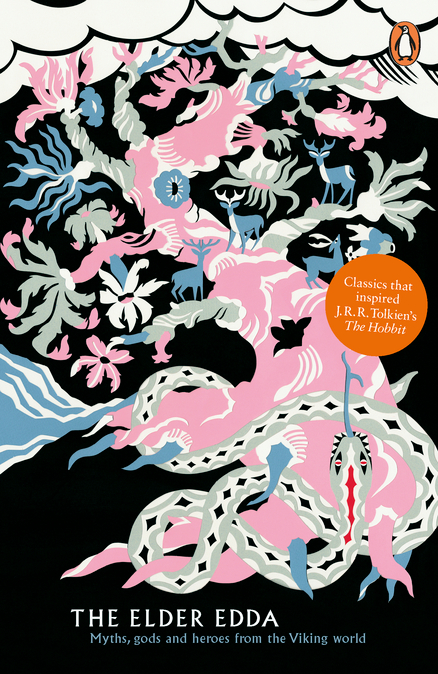
Yggdrasil, the World Tree, as depicted on the cover of The Elder Edda (Penguin, 2013). Art by Petra Börner.
I’ve been slowly reading Snorri Sturluson’s Prose Edda, translated expertly by Jesse Byock (Penguin, 2006), and I wanted to make a post analyzing the threats against Yggdrasil, the World Tree of Norse mythology, and how these threats shape the lives of the gods. I’d like to begin by describing Yggdrasil for any who are unfamiliar with it. This will also help me iron out some of the details as well.
Yggdrasil is described as a tremendous ash tree that holds and supports the nine worlds. Above it is the sky, fashioned from the skull of the giant Ymir and containing the stars, moon, sun, and other heavenly bodies. Below the sky are the branches where a giant eagle named Hraesvelg resides along with four stags that eat the leaves from the branches. Below that is Asgard, the realm of the gods that is linked to Midgard (the Earth) by Bifrost, the Rainbow Bridge. Midgard is enclosed by a barrier that protects it from the giants living outside its borders in Utgard, and encircling Utgard is the giant serpent Jormungand who is so long that he encircles the world with his body and grasps his tail in his mouth. Below Midgard and Utgard are the underworld, a realm of monsters and darkness that is guarded by the great dog, Garm, and the serpent, Nidhogg, gnaws at Yggdrasil’s lowest root. Finally, a squirrel named Ratatosk runs up and down the trunk carrying insults between Hraesvelg and Nidhogg (which I find to be kind of hilarious and awesome).
With this short description, one can tell two things about Yggdrasil. First, that the cosmology of Norse mythology was well-developed and complex, and, second, that it is rife with symbolism. Like the cosmology of other ancient myths, what these symbols actually symbolize is often obscure. There are a few things that are immediately obvious, however, and one of these instantly observable aspects of the myth, as Byock aptly points out in the edition of the Prose Edda that I’m reading, is that Yggdrasil, and the universe by extension, faces constant peril. Indeed, not only Yggdrasil, but Midgard, Asgard, and the sun and moon also face constant peril from giants, wolves, and other creatures and forces. I find this state of constant imperilment especially fascinating. Because of these various threats to Yggdrasil and its realms, the gods of Norse mythology must actively work to hinder an inevitable march towards destruction. Odin himself constantly seeks out wisdom in order to delay Ragnarok as well as prepare for its coming, and Thor constantly fights giants and monsters to prevent them from encroaching into other realms. They are a far cry from the gods of Greek mythology who sit on thrones and who settle their petty squabbles at the cost of countless mortal lives (Odin seems quite petty with his favoritism as well, but I think this is because he wants warriors to fight alongside the gods as Einherjar during Ragnarok rather than letting them die as a result of his own pride and vanity). This slow yet progressive march towards entropy (see, I told you I love science!) can be taken any number of ways. However, I find that the complex symbolism obscures what is otherwise a relatively simple meaning: Life requires work.
The effort required to sustain life makes sense in the context of Norse mythology. Norse myth is a brutal world where a moment’s hesitation, letting your guard down, or just general lethargy can lead to disastrous consequences. This is perhaps most evident in the myth that chronicles the tragic death of Baldr. He was the most beautiful and loved of the gods, and in order to protect him from harm, his mother Frigg (who was also Odin’s wife) made all forms of life promise that they would never do harm to Baldr. All except mistletoe, which proved to be his bane. Frigg thought mistletoe was too insignificant, too non-threatening, and too young to pose a danger to Baldr, and this oversight cost her dearly when Loki wove a spear of mistletoe and tricked the blind god Hodr into throwing it at Baldr, thus killing him. The slightest mistake, the smallest oversight, and the tiniest stumble can lead to utter devastation.
Yggdrasil and the worlds that rely on it all stand on the brink, and if the scales tip the wrong way the universe will be thrown into chaos. In order to postpone the universe’s inevitable collapse. The gods had to do three things. First, acquire knowledge and the wisdom to utilize that knowledge. This is primarily Odin’s sphere (bonus points to any who catch onto this pun!). This grim god sacrifices his eye, hangs himself from a tree, and disguises himself and travels to other realms where he questions and tricks unsavory beings at great peril to himself in order to gain as much knowledge as he can to stave off Ragnarok as well as prepare for its eventual coming. Second, is defending the realms in the present. This is usually Thor’s job, though he does often have companions. He is often away from Asgard fending off giants and other beings from encroaching onto the border of Midgard, and though he may not be the brightest bulb in the Norse pantheon, he is a fearsome warrior who will play a crucial part in Ragnarok. Lastly, any damage done must be repaired. This is typically symbolized to be the role of the Norns, three women who use mud to heal the naturally occurring rot in Yggdrasil’s trunk.
The real kicker is that regardless of all this effort, it’s futile. Though it isn’t clear if Yggdrasil will die at Ragnarok, it will at the very least be affected by the last battle at the end of the world, and the gods know this. Each god also knows how they will die. Knowing this, the question remains, why do they continue to fight, to gain knowledge, and repair the damage to Yggdrasil when they know how their ultimate end? Why don’t they just give up and allow fate to take its inevitable course?
The answer is that the Norse gods must fear something else even greater than Ragnarok, but what?
I’m just over 1000 words now, and I’d like to keep each post around that length, so I’ll conclude this discussion in the next post. Stay tuned!
Welcome to Weland’s Work, my new medieval literature blog! I read a fairly decent amount of medieval literature, and at some point I’d like to complete a PhD focusing on the medieval literature of Northern Europe. This includes Germanic and Celtic epic poetry, mythological tales, and numerous prose works.
Medieval literature is a real passion of mine, and when I explain this to people they often either ask me why, or give me a look I think they’d typically reserve for people they think have just escaped from a mental institute. Though I know there are a lot of other folks out there who share similar interests, it still sometimes seems rare that I find someone with these interests. There was one time over the last year that an acquaintance of mine was looking at a medieval book I was reading (I believe it was The Nibelungenlied). Upon perusing the description on the back cover, this person asked me if The Nibelungenlied is actually historical, or if it is fictional. I explained that it contains historical figures, and that many of the events therein were likely inspired by actual, historical events. There is also a lot of fiction and embellishment added for good measure. This person, who is definitely a reader, proceeded to explain to me how books like The Nibelungenlied no longer matter in the scheme of the contemporary world, and aren’t worth reading. This because the people that appear in medieval texts are long dead (if they even existed in the first place), and that the culture is so far removed from our own. To explain their own interests, this person proceeded to tell me about a book that was essentially a history of a neighborhood in Brooklyn in the first half of the 20th century, and how that has value and relevance due to its locality, and its being fairly recent.
I didn’t point out that medieval texts are similar to the neighborhood history book more ways than one might expect. Many medieval texts, like this Brooklyn neighborhood history, were often a way that a certain people established a cultural identity. Truthfully, The Nibelungenlied and the book my acquaintance had mentioned were not as drastically different as they may have thought as they both arose from a culture attempting to establish an identity: the where we come from and how we made it here. That all being said, I can still understand why people have an aversion to reading medieval texts, because despite any similarities they may have with more contemporary writings, there are still plenty of aspects that make them dissimilar. On top of that is the fact that most are in archaic languages. As such, most medieval texts are printed in translation and supplemented by an abundance of footnotes or endnotes in order to allow modern readers to actually read and understand them (ideally).
Yet even with the best translations and the most scrupulously researched and detailed notes, many medieval texts are still daunting juggernauts to modern readers and they remain just as impenetrably unintelligible as though they were still in their original language. It can be frustrating, and as someone who reads translated medieval texts on a fairly regular basis, I can sympathize with people that don’t want to go to the trouble of reading them. I’ve found that one cannot read and understand a medieval text without also studying it, and that can be hard. We’re trained to read by reading much more contemporary texts (novels, non-fiction, and poetry), which isn’t a bad thing by any means. Yet, our own novels and stories come to us with hundreds, even thousands of years of the development of written narrative as a form of expression. Our own, contemporary narratives tend to be slick, clean and to the point with no distractions, while medieval works are rougher, and filled with side stories, genealogies, and obscure references that often times makes them much more difficult to follow than contemporary texts. All of this tends to mean that medieval texts aren’t widely read outside of academia.
Yet I find that that the strange narrative structuring that is so alien to us is actually what draws me to these texts. I find the distractions and odd narrative instances and asides fascinating. For instance, Beowulf begins by describing the genealogy of the Danish kings, beginning with Scyld Scefing. Why start there? There are a lot of theories and criticism giving various reasonings, and, despite these great theories, we can’t ever know for sure why the poet would include this episode in particular without actually talking to him or her. It’s a mystery.
Medieval texts are full of mysteries. Things we’ll never be able to understand despite our best efforts, and this is why I think they’re important. In our contemporary world, science and technology progress and develop at an alarming rate and the world seems to get smaller and smaller with each passing year. But in medieval texts, the world was still expanding, and there were still monsters lurking at its edges and in its dark corners. Medieval texts are raw, imaginative, and at times terrifyingly scary. All of which has little to do with our world of data, computations, and calculations, and it is precisely because of this that I think they’re still relevant, and still worthy of our time and attention. In saying this I don’t intend to dish science or technology (I love both!), and while science and technology don’t exclude imagination at all (one could say they rely on imagination), it often seems they leaves little room for the unknown, the mysterious, and the imaginative without trying to explain it away with a formula or calculation. Medieval literature has a lot of loose ends leaving plenty of room for the unknowable and the frightening, which I think is important in our world of data and logic.